
17 Mar 2026
As galaxies fall under gravity into groups and clusters, they are exposed to a range of violent processes unique to dense environments. Of particular interest is ram pressure, an environmental mechanism that, when powerful enough, can strip a galaxy of its star-forming gas, effectively shutting down its star formation. Remarkably, the existing stellar population is largely unaffected. Galaxies undergoing strong, active ram pressure stripping (RPS) are known as jellyfish galaxies, named for the dramatic tails of stripped gas that trail behind them.
The Coma Legacy IFU Survey (CLIFS), led by Dr. Ian Roberts at the University of Waterloo (Canada), will observe all 29 star-forming galaxies in the Coma Cluster with radio continuum tails, along with a comparison sample of "normal" star-forming galaxies using the WEAVE Large-IFU mode. The Coma Cluster provides an ideal laboratory for studying RPS: it is the nearest massive galaxy cluster and contains an unusually high fraction of jellyfish galaxies, likely due to its high halo mass and ongoing subgroup merger activity.
The CLIFS team is particularly interested in studying emission from jellyfish tails. Previous studies have found evidence for ongoing star formation in the tails, but many such samples were identified based on the presence of extra-planar star-forming knots, possibly introducing a selection bias. In contrast, the CLIFS sample was not selected based on the basis of extra-planar star formation and thus provides a powerful way to constrain how common star formation is, in stripped gas tails.
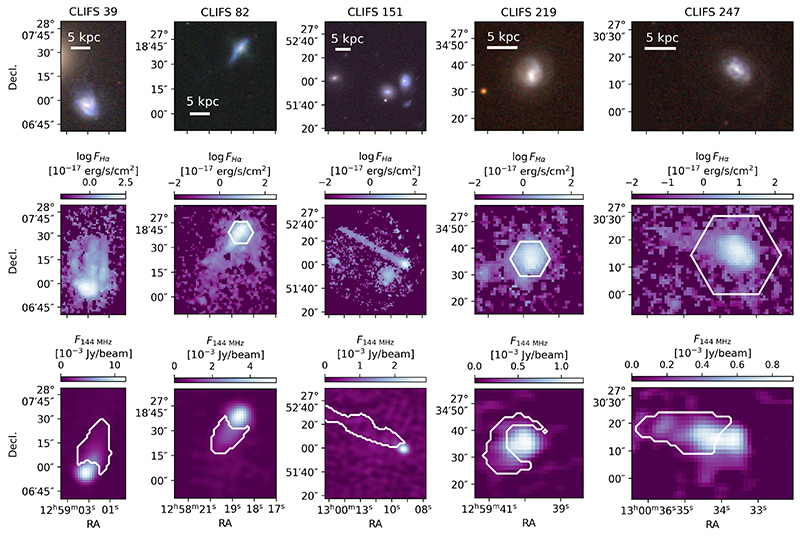
Using a preliminary sample of five jellyfish galaxies, McMaster University (Ontario, Canada) PhD candidate Lauren Foster and collaborators compared Hα emission from WEAVE and 144 MHz radio continuum emission from LOFAR in both galaxy disks and tails. While both tracers typically track star formation, radio emission can be boosted if cosmic rays are accelerated by other processes. The team found that the two tracers agree well in galaxy disks, but that radio-derived star formation rates are much higher in the tails than the Hα-derived values, indicating that star formation is not the dominant source of tail emission.
The CLIFS team takes advantage of the wide spectral range and large field of view provided by WEAVE to determine spatially-resolved emission-line diagnostics and gas kinematics for the stripped material. They find that the stripped gas in the jellyfish tails is excited by shocks driven by ram pressure. This work is just one piece of the broader CLIFS effort. The complete sample will allow the team to fully constrain the fraction of radio tails with active star formation in Coma, as well as spatially resolve star-formation histories across stripped galaxy disks.
[Image]
Top: Colour composite images of the galaxies in the current CLIFS sample, created using SDSS g, r, and i-band imaging. A 5 kpc scale bar is shown in each panel. Middle: WEAVE Hα flux maps for the same fields of view. Hexagonal regions show the MaNGA fields of view for galaxies observed by both surveys, highlighting WEAVE's larger field of view. Bottom: LOFAR 144 MHz radio continuum maps of the same regions. Contours outline the stripped gas tails.