
12 Aug 2025
A stunning new image of a cosmic jet aimed directly at Earth, resembling the mythical “Eye of Sauron” in the distant Universe, has revealed the secret behind unexpectedly bright high-energy gamma-ray and neutrino emissions from a peculiar blazar, potentially solving a decade-long cosmic puzzle.
As part of an international team of researchers, astronomers from the Center for Astrophysics | Harvard & Smithsonian helped achieve a breakthrough in understanding how a blazar with a slow-moving jet could be one of the brightest sources of high-energy gamma rays and cosmic neutrinos ever observed.
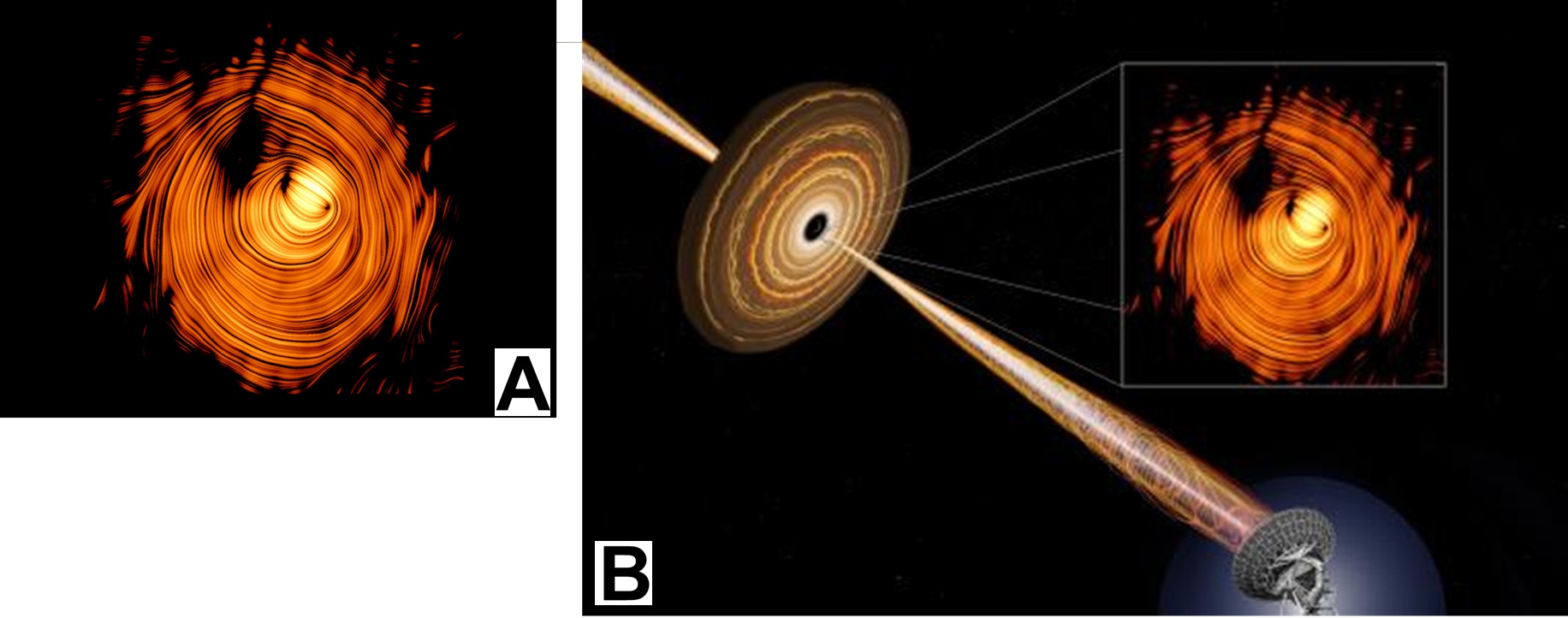
The resulting image, which is the first to directly reveal this type of magnetic field structure, resembles an orange-red eye wreathed in flames: the Eye of Sauron from the mythical Lord of the Rings trilogy.
The findings are published today in Astronomy & Astrophysics Letters.
Located roughly 7.4 billion light-years from Earth, blazar PKS 1424+240— a type of active galactic nucleus powered by a supermassive black hole that launches a jet of plasma moving at nearly the speed of light— has long baffled astronomers. It stands out as the brightest known neutrino-emitting blazar in the sky and glows in very high-energy gamma rays observed by ground-based Cherenkov telescopes.
Yet, oddly, its radio jet appeared to move sluggishly, contradicting expectations that only the fastest jets can power such intense high-energy emissions.
Now, thanks to 15 years of ultra-precise radio observations from the Very Long Baseline Array (VLBA), researchers have stitched together a deep image of this jet at unparalleled resolution.
“We were absolutely stunned to see such a striking image of a blazar jet – this is the first image of its kind that directly reveals the magnetic field structure within the jet cone,” said Alexander Plavin, an astronomer at CfA and post-doctoral fellow at the Black Hole Initiative. “It's like looking straight into the Eye of Sauron.”
Yuri Kovalev, lead author of the study and principal investigator of the ERC-funded MuSES project at the Max Planck Institute for Radio Astronomy (MPIfR) added, “We have never seen anything quite like it — a donut-shaped magnetic field with a jet, pointing straight at us.”
Because the jet is coincidentally aligned almost exactly in the direction of Earth, its high-energy emission is dramatically amplified by the effects of special relativity.
“The half-degree alignment boosts the jet brightness by a factor of more than 30,” explained Alexander Plavin. “At the same time, the jet appears to move slowly because almost all its motion happens towards us — a classic optical illusion.”
This head-on geometry allowed scientists to peer directly into the heart of the blazar’s jet — an extremely rare opportunity. Radio signals helped the team map out the structure of the jet’s magnetic field, revealing its likely donut-like shape. This structure plays a key role in launching and collimating the plasma flow, and may be essential for accelerating particles to extreme energies.
“This discovery helps explain why this blazar is such a powerful neutrino producer – ranking as the second-strongest neutrino source in IceCube's analysis,” said Plavin. “Moving forward, we're working to identify and characterize the entire population of blazars that collectively generate the high-energy neutrino flux we observe on Earth.
This result strengthens the link between relativistic jets, high-energy neutrinos, and the role of magnetic fields in shaping cosmic accelerators — marking a milestone in multimessenger astronomy.
[Image]
(A) The “Eye of Sauron,” a striking image of the plasma jet in the blazar PKS 1424+240, seen head-on. The jet is threaded by a nearly perfect magnetic field, visualized in orange. Due to special relativity, high-energy gamma rays and neutrinos are strongly beamed toward Earth, even though the jet appears slow-moving from our perspective.
(B) Looking inside the plasma jet cone of the blazar PKS 1424+240 with a radio telescope of the National Science Foundation’s Very Long Baseline Array (NSF VLBA).