
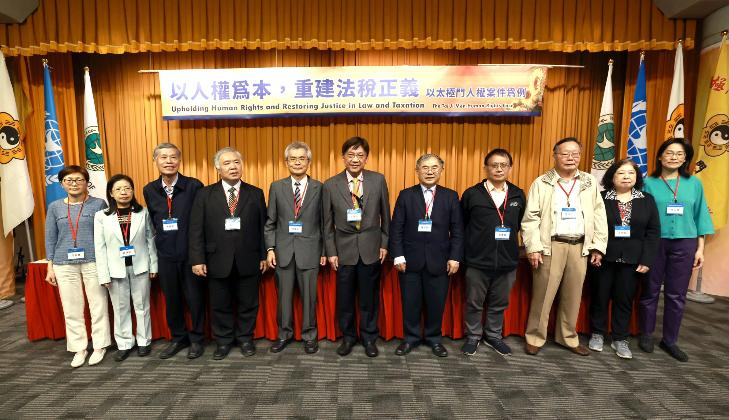
Fig.1. The seminar on United Nations’ Human Rights Day focus on “Based on Human Rights, re-store the Judicial and Taxation Justice” , attracting experts and scholars to contribute their suggestions
May 6th, 2026
During the 2025 Human Rights Day ceremony, President Lai Ching-te reaffirmed that Taiwan is a nation founded on the principles of human rights. He stated that the government will continue its dedicated efforts across three key pillars: investigating the truth to restore history, preserving collective memory to deepen domestic roots, and restoring the reputation and dignity of victims. President Lai emphasized that democracy remains the only path forward for Taiwan, and that the administration will steadfastly uphold the values of peace, human rights, and the rule of law.
Since 2009, Taiwan has incorporated the International Covenant on Civil and Political Rights (ICCPR) and the International Covenant on Economic, Social and Cultural Rights (ICESCR)—collectively known as the 'Two Covenants'—into domestic law. As the 2026 National Human Rights Report undergoes its fourth international review, we must ask: how far is the gap between Taiwan’s human rights practices and international standards?
During the seminar held on December 10, 2025, titled 'Reconstructing Justice in Law and Taxation Based on Human Rights: The Case of Tai Ji Men,' experts and scholars examined the Tai Ji Men case through the lens of the Constitution and the Two Covenants, discussing the illogicality for imposing statute of limitations on the pursuit of justice when human rights violations are concerned.
At the same time, the Center for Studies on New Religions (CESNUR) and Human Rights Without Frontiers (HRWF) co-organized an online seminar titled "The Tai Ji Men Human Rights Case Enters Its 30th Year." Dr Massimo Introvigne – Italian sociologist, Executive Director of CESNUR, and Editor-in-Chief of Bitter Winter magazine—noted that the seminar served two purposes: to honor the dignity and freedom symbolized by Human Rights Day, and to acknowledge that the Tai Ji Men case is now entering its third decade.
He shared that the Tai Ji Men Grandmaster and his dizi have turned injustice into inspiration and transformed their hardships into actions that honor human dignity. Their testimony, symbolism, and persistent peaceful protests have evolved into a "cultural performance" centered on conscience. This movement has crossed borders and now resonates deeply with human rights defenders all around the world.
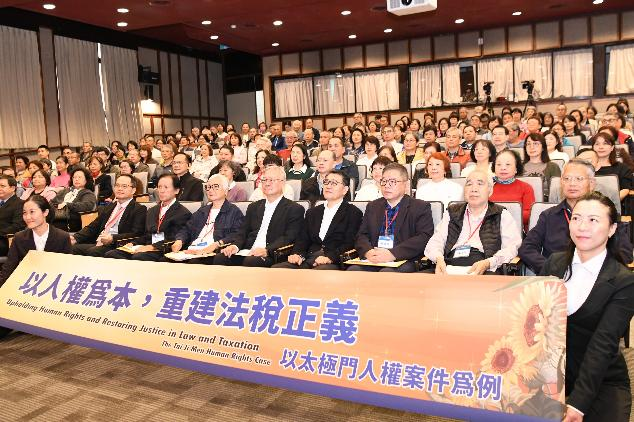
Fig.2. The Seminar on United Nations’ Human Rights Days was held at the International Conference Room in Institute of Applied Mechanics, National Taiwan University
Tai Ji Men case in violation of the Universal Declaration of Human Rights
Widely support from international and domestic experts
Massimo Introvigne emphasized that the course of the Tai Ji Men case is a rare example of how suffering can be transformed into profound meaning.
He noted that their movement carries a sense of rhythm, symbolism, and emotional depth: the beating of drums, the resonance of the Bell of World Peace and Love, and the quiet strength of disciples who refuse to give in to despair. Such perseverance, he said, is not only a legal struggle but also a ritual of resilience—one that inspires others to imagine that justice, too, can be expressed with such beauty
Márk Nemes, research fellow at the Institute for the Theory and Methodology of Art of the Hungarian Academy of Arts and Deputy Director of CESNUR, emphasized that a place of practice is vital to the identity of a spiritual community. It is not only a symbol of resilience, but also a unifying banner.
He stressed that every spiritual group has the right to designate its own sacred space, and that the Tai Ji Men practice site should have been preserved, free from interference by secular authorities. He further noted that this case is not merely about property—it also involves depriving a community of its right to build and sustain its spiritual home.
Hans Noot, Chair of the Gerard Noodt Foundation for Freedom of Religion or Belief, emphasized that true justice is not limited to a verdict of innocence—it also requires concrete follow-up actions. These include returning confiscated property, revoking improper tax assessments, and establishing safeguards to prevent future abuses of power.
He pointed out that without the security of property rights, no group can freely organize, practice its beliefs, or maintain its basic livelihood.
Willy Fautré, co-founder and director of Human Rights Without Frontiers, stated that discriminatory taxation is in effect “a form of persecution tolerated by society,” undermining equality before the law.
He noted that the Tai Ji Men case has gone nearly 30 years without redress, and argued that Taiwan should at the very least issue a formal public apology.
Marco Respinti, Director of Bitter Winter, an Italian scholar and Journalist, stated that Tai Ji Men has chosen to respond to injustice with patience, compassion, and good deeds.
He noted that over 30 years of hardship, Tai Ji Men has transformed its suffering into three decades of dedication to human freedom, demonstrating resilience and a clear moral stance. By refusing to repay wrongdoing with wrongdoing, Tai Ji Men offers a rare and exemplary response to injustice—one that shows true justice lies not in retaliation, but in conscience and the commitment to doing good.
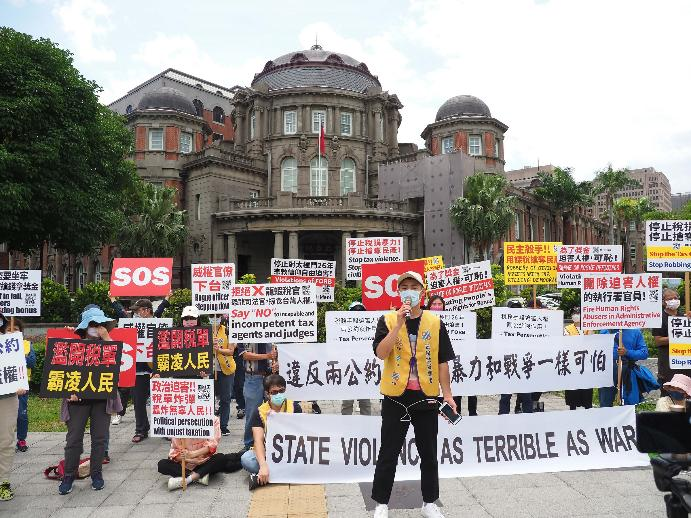
Fig.3: The volunteers protested in front of Control Yuan, Taiwan, arguing that the state violence in breach of two Covenants is as horrible as war
Looking Through the Lens of News: A Global Effort to Preserve Precious Culture
Established in 1966, the Tai Ji Men Qigong Academy has dedicated itself to a noble mission since its inception. The contributions traditionally gifted to the Grandmaster by his dizis have been used entirely for the benefit of the dizis, the betterment of society, and the promotion of a global culture of love, conscience, and peace.
Despite facing significant challenges, the Tai Ji Men master and his dizis have remained true to the spirit of martial arts practitioners—focusing on helping others and promoting cultural heritage. Their impact is felt both at home and abroad:
- National Pride: They have performed at eight National Day celebrations and six "Global One Heart" National Day galas in Taiwan.
- Global Reach: With a mission to help people with love, they have conducted cultural exchanges and promoted civil diplomacy worldwide. As of August 2025, they have visited 120 countries, receiving warm reception wherever they went.
- International Recognition: Widely praised as "International Ambassadors of Peace and Goodwill," the group played a pivotal role in the United Nations' designation of:
- April 5th as International Day of Conscience.
- July 12th as International Day of Hope.
In addition, in April 2025, Dr Hong , the Grandmaster, started a global call to promote Transparency and Integrity. This initiative advocates that every level of society—from national judicial and tax systems to international economic activities—must be guided by honesty and conscience. So that we can:
- Improve the efficiency of our social systems.
- Achieve economic development and prosperity.
- Ensure that the protection of human rights is fully realized.
This vision has gained incredible momentum. By December 1, 2025, influential leaders and citizens from 149 countries—including UN Ambassadors, former heads of state, government officials, and Nobel Peace Prize laureates—have endorsed to show their support.
Reflecting on the importance of heritage, former Legislator Cheng Feng-shih noted on August 17, 2003 "Our government should do more to encourage the passing down of culture. Once culture is interrupted, our roots are severed. We cannot allow the pulse of our tradition to stop. I believe Tai Ji Men's work is essential because it truly represents the transmission of culture."
In recent years, the Taiwanese government has significantly increased its budgets for the Ministry of Culture and the Ministry of Foreign Affairs. From 2021 to 2024, the combined budget for the Ministry of Culture and the Ministry of Foreign Affairs grew by approximately 26%, rising from NT$48.576 billion to NT$60.966 billion (with NT$29.825 billion for Culture and NT$31.141 billion for Foreign Affairs).
In striking contrast, the Tai Ji Men have visited 120 countries entirely through their own efforts. They have self-funded every journey, successfully promoting cultural exchange and international goodwill without receiving a single cent in government subsidies.
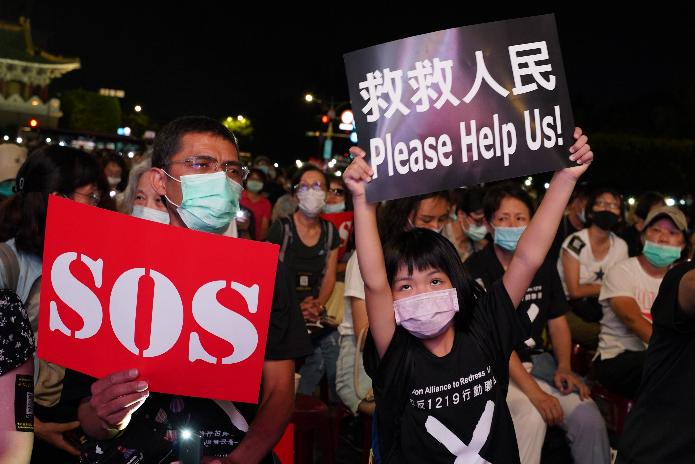
Fig.4: Protest on Ketagalan Boulevard, a call for the government to protect Human Rights. Even the kids came to join the parade in order to safeguard their future
Does the Principle of "Res Judicata" Have No Limits?
Solution can be identified from The Article 117 of Administrative Procedure Act
Professor Huang Chun-chieh, Distinguished Professor of Financial and Economic Law at National Chung Cheng University, pointed out that the final criminal court ruling has determined that the "red envelopes" (disciples' gifts to their master) were tax-exempt gifts. Furthermore, an inter-ministerial investigation by the Executive Yuan collected 7,401 affidavits confirming this gift nature. Despite being powerful new evidence, these findings were not considered in the final administrative judgment for the tax year 1992. In addition, the National Taxation Bureau (NTB) has recognized the income as zero for other years, yet inconsistently labeled the academy as a "cram school" for the year 1992, maintaining a tax demand. This inconsistency between judicial findings and administrative tax actions creates a logical and legal paradox.
Professor Huang emphasizes that this contradiction directly violates the fundamental rights of taxpayers. He calls for a re-evaluation of the applicability of Res Judicata (the finality of judgments) in tax cases.
The goal is to ensure that "legal finality" does not override substantial justice, in order to truly uphold the human rights protected by the Constitution.
Attorney Huang Di-Ying, a member of the Human Rights Committee of the Taipei Bar Association, stated:
Regarding the tax assessment issued in 1992, the tax authority had determined that income of the same nature over a total of five years—both before and after—qualified as tax-exempt gifts. However, it chose to impose tax only for that particular year. This action clearly violates the “principle of administrative self-binding,” which is derived from the constitutional principle of equality, and therefore constitutes an unlawful administrative decision.
The tax authority should, in accordance with Article 117 of the Administrative Procedure Act, make use of its mechanism for self-correction by proactively revoking the past unlawful decision. Only through thorough reflection and correction of its errors can an enhanced environment for freedom and the rule of law be established.
Professor Wu Chih-Kuang, Professor of the Department of Law and Dean of the College of Law at Fu Jen Catholic University, stated:
Article 117 of the Administrative Procedure Act was originally intended to correct unlawful administrative decisions. However, it has been narrowly interpreted as merely a discretionary power of administrative agencies, without recognizing the public’s right to file a claim. In addition, the concept of res judicata is often overstretched, rendering Article 117 virtually ineffective in practice.
The Tai Ji Men case is a typical example of a violation of the principle of equality: “the same taxpayer and the same taxable facts,” yet only the 1992 tax year remains disputed. Requesting the revocation of the unlawful tax assessment under Article 117 is not only legally justified, but also a necessary step to uphold the rule of law and protect human rights.
Adjunct Professor Huang Jin-Tang of Fu Jen Catholic University stated that there are two possible approaches to resolving the Tai Ji Men case: First, it can be argued that the administrative disposition in question is void; Second, it may be revoked under Article 117 of the Administrative Procedure Act. The challenge, however, lies in the rigidity and mindset of career civil servants. The fact that the case has persisted for so long indicates that a grievance remains unresolved. Senior officials—such as the Director-General of the National Taxation Bureau and high-ranking officials in the Taxation Administration Department in the Ministry of Finance —should conduct a thorough review of the case.
Moreover, political appointees should be held to an even higher standard. They have not demonstrated sufficient empathy or responsiveness to the public’s hardships. Tai Ji Men has maintained a firm position throughout, and its Shifu (Grandmaster) has led dizis in making significant contributions, serving as a positive force in society. This should be valued, and concrete steps should be taken to bring the matter to a proper resolution.
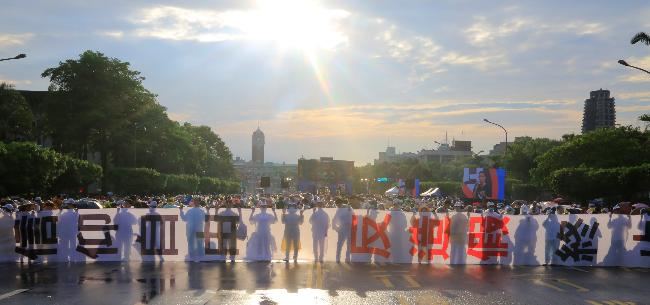
Fig.5:‘Against False’ parade marching under the rain. Participants held a banner of protecting belief, hoping that the light will shed the future
A judge’s deep concern: In a society governed by the rule of law, unjust and unfair decisions cannot be tolerated.
Mr Wen Yao-yuan, former judge, presiding judge, and spokesperson for the Taiwan High Court, stated that in a country governed by the rule of law, unjust or unfair judgments should not be allowed to stand.
However, in the Tai Ji Men case in Taiwan, monetary gifts known as “respective offerings to a master,” given by dizi (disciples) to their Master, were recognized as tax-exempt in all years, except 1992, where this specific tax year was treated differently and deemed taxable. This inconsistency, he noted, goes against principles of fairness and justice, contradicts the Constitution, and undermines various legal protections.
He further criticized the government for not actively resolving the issue and instead imposing compulsory enforcement to seize the sacred land belonging to Tai Ji Men and transfer it into state ownership. He described this as “the worst possible example” set by the authorities.
Lin Wen-chou, adjunct professor in the Department of Financial and Economic Law at National Chung Cheng University, stated that the most fundamental principle for a government is to act in accordance with the law. When an administrative agency issues an unlawful decision, it should have the courage to correct its mistake—this, he emphasized, is the very purpose of the state’s existence. “Legal stability” should not be the excuse for lasting mistakes.
Lin further suggested that even after a decision has become final, government agencies can still revoke the original administrative disposition in accordance with Article 117.
Yuan Tsung-chen, former presiding judge of the Taichung Branch of the Taiwan High Court, analyzed that the 1992 tax case involving Tai Ji Men case has two key issues: procedural illegality and substantive illegality.
He explained that under Article 83-1 of the Income Tax Act, the use of indirect methods to estimate tax liability requires certain conditions: there must be clear suspicion of tax evasion, and more importantly, prior approval must be obtained from the Ministry of Finance. However, neither requirement was satisfied in this case. At the time, Hsu Chun-an, then Deputy Director-General of the Taxation Administration, acknowledged that the tax authorities had made an error—specifically, that this required step was missing and could not be remedied afterward, meaning the authorities should have conceded the mistake.
Yuan therefore suggested that the government could take the initiative to revoke the wrongful administrative decision in accordance with Article 117 of the Administrative Procedure Act.
Chen Chih-hsiang, former presiding judge of the Keelung District Court, stated that the Tai Ji Men case is an important human rights case.
He emphasized that the issue stemmed from a state’s wrong doing, the state should take initiative to correct it. He believes the best and fastest solution is for the government to revoke the original administrative decision under Article 117 of the Administrative Procedure Act.
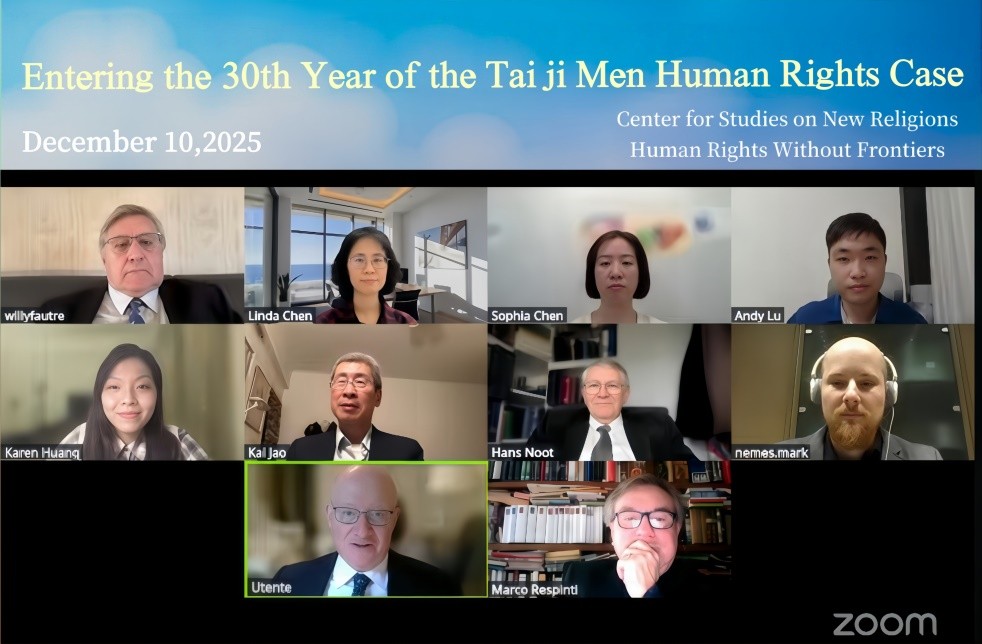
Fig.6:To commemorate United Nations’ Human Rights Day, CESNUR and HRWF co-organized an online seminar titled “Tai Ji Men case in 30 years’
Implementing the Two Covenants and rectifying false cases
A democratic model that respects human rights
Wang Ming-yi, a Public Certified Accountant, stated that the so-called Tai Ji Men false case was caused by administrative errors made by government agencies.
He noted that since Taiwan has incorporated the two international human rights covenants into domestic law, all branches of government have both a political responsibility and a legal obligation to provide effective remedies.
He further explained that even when a court judgment has been made final, administrative agencies can still revoke unlawful tax assessments on their own initiative under Article 117 of the Administrative Procedure Act. He also argued that courts should directly apply the two covenants to ensure effective relief, and that the legislature has a duty to promptly amend laws to remove obstacles in retrial procedures in order to create proper legal channels for redress and rights protection.
Chuang Mei-hui, a Public Certified Accountant, stated that the United Nations Human Rights Committee, in its General Comment No. 22, affirms that freedom of inner belief is an absolute right, while the external manifestation of religion or belief must be governed by law.
Tai Ji Men is an ancient Qigong and martial arts cultivation school, which falls within the scope of religious or belief groups protected under Article 18 of the International Covenant on Civil and Political Rights.
In the Tai Ji Men case, she argued, the National Taxation Bureau imposed taxes and heavy penalties without proper investigation, and even auctioned land intended for a cultivation center. These actions, she said, violate the freedom of religion or belief guaranteed under the Covenant, disrupt the normal operation of the spiritual group, and are clearly against international human rights standards.
Huang Ching-hsun, former prosecutor, stated that for nearly 30 years, the master and dizis of Tai Ji Men have been burdened by tax bills that were wrongly characterized from the outset in terms of the nature of the income, yet they still have not received effective relief.
She pointed out that this situation violates the right to an effective remedy, as guaranteed under Article 2, Paragraph 3 of the International Covenant on Civil and Political Rights, as well as General Comment No. 31. She further described the Tai Ji Men case as a landmark example of the Taiwanese government infringing on freedom of thought and belief.
In 2025, United Nations Human Rights Day also marks the 16th anniversary of the implementation of Taiwan’s Act to Implement the Two Covenants. The two Covenants are not merely symbolic commitments—they are obligations that the state must fulfill.
True rule of law lies in the government itself abiding by the law and in safeguarding people’s dignity, freedom, and property rights—not in imposing harsher penalties or requiring citizens to bear unjust consequences due to procedural flaws.
This is a call for the government to seriously address issues related to law, taxation, and human rights, to promptly advance transitional justice, and to repair institutional shortcomings. Public authority must be brought back in line with the rule of law, so that people can genuinely feel protected by the state and so that human rights injustices are not repeated in Taiwan.