
24 Apr 2026
Diversity reigns across the farmland of Yunlin County in southwestern Taiwan—a region that produces an array of crops on small farms.
About 23 million people live in Taiwan, a Pacific island about the size of Maryland. Despite its size, the island produces a tremendous amount of agricultural goods per year—about $18 billion, according to Taiwan’s Ministry of Agriculture.
The average size of a farm in Taiwan (less than 1 hectare) is much smaller than in the United Kingdom (87 hectares) or the United States (187 hectares). Since much of the island is mountainous, only about one-quarter of Taiwan’s land is arable, and it is mostly located on the southwestern side of the island in the Chianan Plain. That amounts to 0.03 hectares of farmland per Taiwanese citizen—about half as much arable farmland as there is per person in the United Kingdom and one-tenth as much as in the United States.
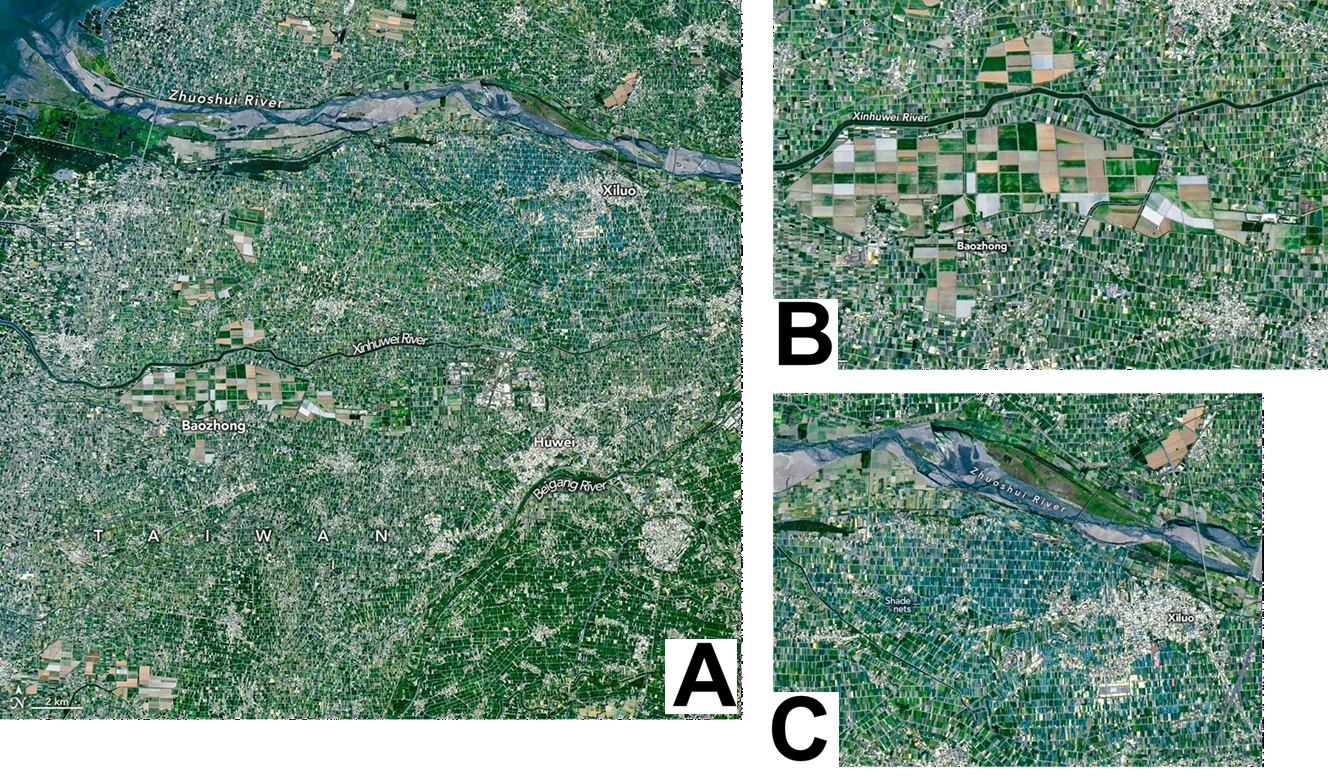
The small plot size is apparent in this satellite image of farmland in Yunlin County in southwestern Taiwan, one of the island’s most productive agricultural areas. The small size of farms is partly a result of past policies that limited the size of farms and partly a byproduct of cultural traditions that often lead to the division of farms into smaller parcels as property is passed from one generation to the next.
Located along the floodplains of the Zhoushui and Beigang rivers, Yunlin County is mostly flat, has fertile soils, and enjoys easy access to irrigation water. The county, one of Taiwan’s main agricultural hubs, is known for producing a wide range of crops, including rice, sweet potatoes, peanuts, corn, sugarcane, garlic, scallions, coffee, fruit trees, and leafy greens. Farms in the county also raise millions of pigs, the most of any county in Taiwan.
Most crops in Yunlin County are grown in small rectangular plots defined by roadways and networks of irrigation canals. The exception is sugarcane, which was grown widely in the county in the early 1900s when Japan controlled Taiwan and established an expansive network of sugarcane plantations in the southwestern part of the country. These plantations were consolidated into Taiwan Sugar Corporation after the conclusion of World War II, and the large plot sizes in the farmland north of Baozhong in the image above persist as a legacy of this period.
While the amount of sugarcane cultivated in Taiwan has declined in recent decades and many of the fields have transitioned to other crops, Taiwan Sugar Corporation still raises sugarcane around Baozhong. The company operates a railway that transports harvested cane to nearby Huwei, site of one of just a few remaining sugar refineries on the island. While Taiwan also once had a large network of sugar railways that serviced thousands of kilometers of track and dozens of sugar refineries, the line that serves Huwei is the only one on the island that remains active.
Another area that stands out in the mosaicked agricultural landscape of Yunlin is located around Xiluo (above). Here the fields take on an unusual greenish-blue hue, largely because of the ubiquity of shade nets. Farmers use the nets to protect crops from heat, sun, heavy rains, and pests. They’re generally deployed for specialty crops such as vegetables, fruit, and flowers. This area contrasts with the darker green region in the lower right of the first image, where rice is the dominant crop.
[Image]
(A) Farms raising an array of crops form an agricultural mosaic across Yunlin County in this image captured by the OLI (Operational Land Imager) on Landsat 9 on March 18, 2026.
(B) Areas with large fields were generally once part of sugar plantations.
(C) Farmers around Xiluo often use shade nets to protect crops from the elements.