
7 Sep 2026
Using the WEAVE instrument on the William Herschel Telescope (WHT), astronomers from Northumbria and Edinburgh universities in the UK have uncovered new clues about interstellar comet 3I/Atlas. Their findings, supported by Director's Discretionary Time (DDT), reveal that the comet formed in extremely cold conditions, far from any star.
Every so often, a large icy rock, similar to a comet, arrives from beyond our Solar System, having formed around a different star entirely then travelling for millions of years before reaching us. These are called interstellar objects, and only three have ever been spotted. The most recent, known as 3I/ATLAS, was discovered in July 2025 as it sped past the Sun and back out into deep space.
Because these objects formed in a completely different part of the galaxy, studying them gives scientists a rare glimpse into how planets and comets form around other stars, not just our own.
Dr Lea Ferellec, a Research Fellow based in Northumbria's School of Engineering, Physics and Mathematics, led a study looking at the ionised gases streaming off 3I/ATLAS as it moved away from the Sun. By combining WEAVE's LIFU imaging spectroscopy with the WHT's new non-sidereal guiding capabilities, the team identified five different ions in the comet's stream simultaneously. This is a rare achievement for any comet, and a remarkable first for an interstellar object of this nature.
By measuring how much dinitrogen gas was present compared to carbon monoxide, the researchers worked out that 3I/ATLAS formed somewhere extremely cold, likely colder than -240°C. This suggests it formed a long way from its home star, in the outer, icier edges of wherever its solar system took shape.
Speaking about the findings Dr Ferellec said: "This object gives us a rare chance to study material that formed somewhere completely different to our own Solar System. Finding that it's so rich in nitrogen tells us it likely formed in extremely cold conditions, far from its home star. Every one of these objects we study helps us understand a little more about how planets form around other stars."
The team also looked at how the ions changed the further they travelled along 3I/ATLAS's tail, which forms when plasma streaming from the Sun sweep the object's charged particles out behind it. This is the first time this level of detail has been captured for an object of this kind.
"Powerful, large-format IFUs with high sensitivity in the blue optical spectrum—like WEAVE-LIFU on the WHT—are opening new frontiers for the study of comets and other solar system objects", says Rubén Sánchez-Janssen, ING Director. "This discovery is a perfect example of the value of DDT, which is specifically designed to enable observations of exceptional and urgent scientific importance".
[Image]
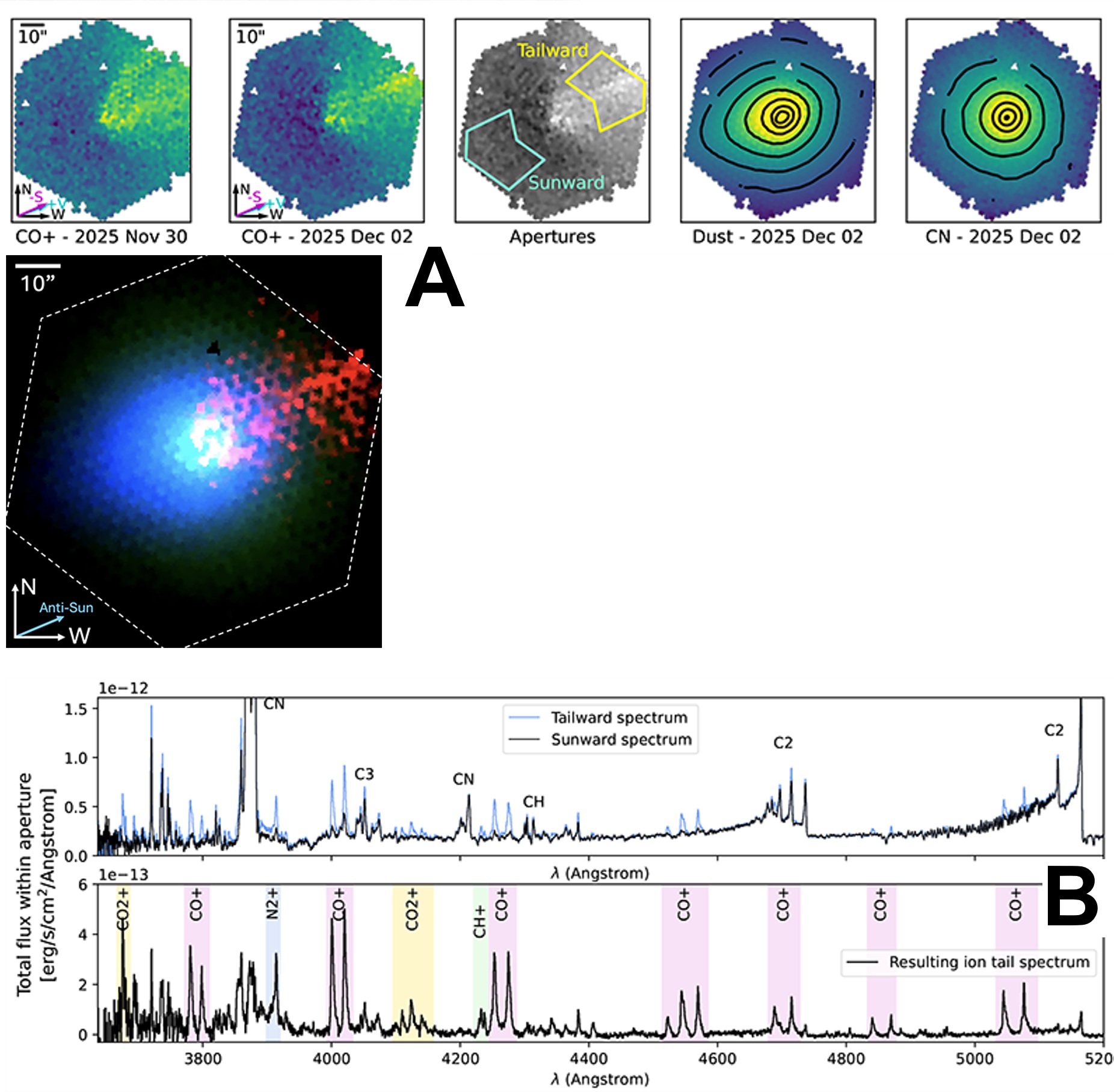
(A) Top: CO+ ion maps (first and second panel). The ion tail is visible, close to the expected anti-solar direction. Arrows indicate the anti-solar direction ("-S") and the direction of motion ("+V"). Apertures to extract tailward and sunward spectra are illustrated in the third panel. A dust map (fourth panel) and a CN map (fifth panel) show that the dust coma extends into a sunward tail while the gas coma looks more symmetrical. Figure extracted from Ferellec et al., 2026, MNRAS, stag1402.
Bottom: The different distributions of dust (blue), gas (green) and ions (red) around 3I/Atlas.
(B) Example of tail-side and antitail-side spectra from the LIFU blue arm, the locations of the apertures having been optimised to have similar gas and dust spectral components. Emission regions of the main neutral volatiles are labelled on the spectrum. Some emission lines are visible that are stronger in the tailside spectrum, showing that they are due to ions in the plasma tail. Bottom: Isolated ion emissions resulting from the subtraction of the antitail-side spectrum from the tail-side spectrum. The most prominent emission lines are labelled.