
28 Jul 2026
Almost all reforestation projects are done the same way they’ve been done for a century: with shovels and bags and seedlings. But University of Toronto alumnus Cameron Jones says there’s a better way.
In 2003, Cameron and his brother Bryce were living with their family on the edge of Okanagan Mountain Park in British Columbia. That August, the region made international headlines after a lightning bolt started a wildfire that spread across 250 square kilometers and destroyed 239 homes. Twenty-three years later, the land remains barren.
Inspired by the devastation they had seen as children, the Jones brothers set out to tackle the forest loss caused by wildfire, extreme heat and drought – all exacerbated by climate change. In 2019, together with Angelique Ahlström, they founded reforestation company Flash Forest, using specialized delivery drones and helicopters to allow large-scale tree planting in areas that would otherwise be extremely hard to reach.
With support of U of T’s iCUBE accelerator, the team worked in U of T Mississauga’s greenhouses to refine their proprietary seed pods, which are then combined with advanced imaging, machine learning and automation to reforest areas devastated by wildfire.
This spring, U of T Facilities & Services partnered with Flash Forest to plant 68,345 trees in the Assinica Wildlife Reserve in northern Quebec. The area – located on the traditional, ancestral and unceded territory of the Oujé-Bougoumou Cree First Nation, a partner in the project – was ravaged by wildfires in the summer of 2023.
“The experience we had with Flash Forest, it was a wonderful experience. It feels positive to engage with the technology,” says Jimmy Lord, director of the Assinica Wildlife Reserve and member of the Oujé-Bougoumou Cree First Nation. “I think it’s going to facilitate the new generation to learn these new technologies.”
Planting is done with drones and helicopters that shoot specialized seed pods directly into the ground, embedding them in the soil. Each pod is created in Canada and contains both nutrients and special water-retention capabilities to sustain the seedling in its critical first two years.
Jones, who earned a master’s degree from the Henry N.R. Jackman Faculty of Law, says the partnership with the Oujé-Bougoumou Cree First Nation was core to the project and critical to its success. “The community has helped with everything from species selection and site access to actually helping with our cone collection efforts – they’ve collected millions of local seeds,” he says.
The project is supported by the Carbon Reduction Fund managed by the U of T Sustainability Office on the St. George campus. It finances greenhouse gas emissions reduction projects to offset travel-related emissions generated by the university.
Over the next 100 years, the newly planted trees are expected to capture and eliminate a projected 33,000 tonnes of CO2. Other benefits include soil stabilization, caribou and bald eagle habitat restoration, protection of rare forest-floor flora and an improvement to air quality.
“It was incredible getting to work with the team at U of T,” says Jones. “We’ve all been blown away by how involved U of T’s team was in this project, how committed they are to actual environmental initiatives and the rigour of the carbon modelling team.”
[Image]
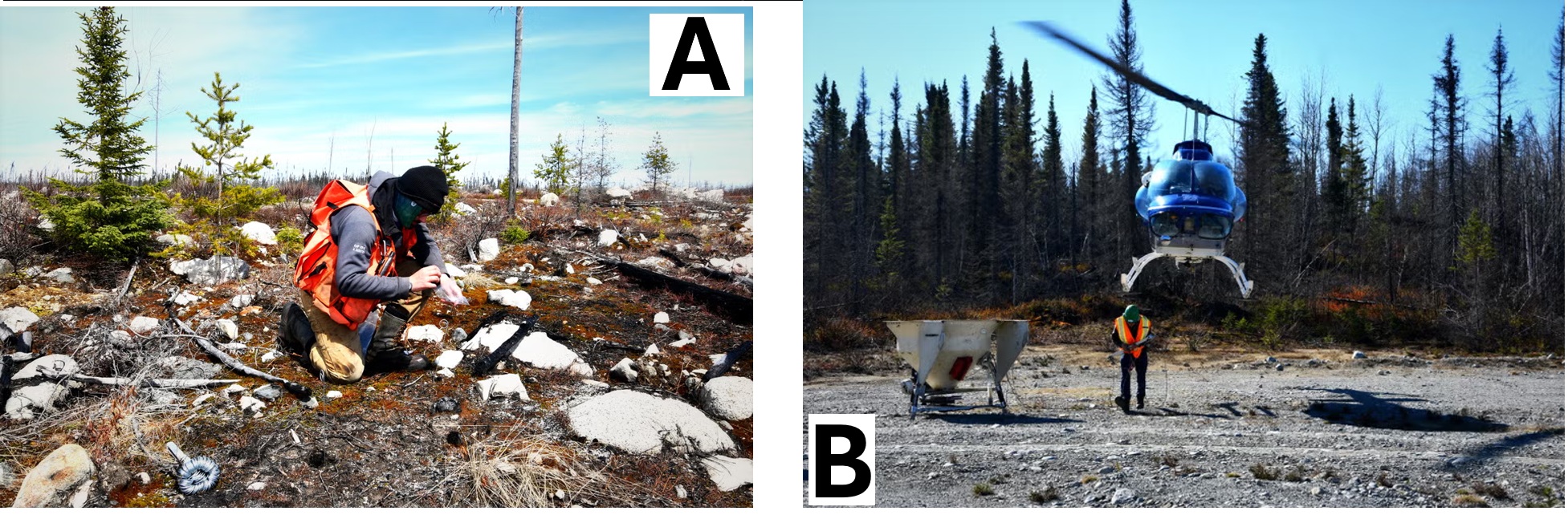
(A) After carefully studying the landscape, Flash Forest – co-founded by U of T alumnus Cameron Jones – uses specialized delivery drones and helicopters to allow large-scale tree planting in areas that would otherwise be difficult to reach
(B) Loaded with proprietary seed pods engineered by Flash Forest, a helicopter sets out to begin its planting mission