
1 Oct 2026
In a recent issue of Frontiers, CfA Senior Astrophysicist Martin Elvis examines what it would take to establish a human presence on the Moon—and why its limited water resources may not be sufficient to sustain us.
The discovery of water in dark craters at the Moon's poles has sparked a ‘moon rush’ to establish bases there, and then villages, cities, and heavy industry. How sustainable is this rush?
Soon after the Moon was formed, asteroids bombarded it, creating its pockmarked topography. Near the Moon’s poles, there are dozens of crater floors that have not seen direct sunlight in about four billion years. Many of these cryogenically cold ‘pits of eternal darkness’ are below a temperature of 110K, forming ‘cold traps’ in which water ice won’t sublimate away by more than a millimeter in a billion years, even in the vacuum at the Moon’s surface. And there is water to freeze: some of those asteroids brought it along with them. Since 2013 we have known that that water is still there, possibly as much as a billion tons of it, thanks to a succession of Moon-orbiting missions that have mapped out likely locations in increasing detail.
The presence of water at the lunar poles changes everything about human visits to the Moon. Suddenly it is practical to envisage a ‘Moon village’ where people could survive without importing every last bit from Earth. They could grow their own food and have showers and functional toilets, unlike the astronauts on the International Space Station (ISS). This possibility has sparked ambitions from the likes of Jeff Bezos to move heavy industry to the Moon and Elon Musk’s aims to have “self-growing cities” there. These are enticing visions, but are they attainable?
[Image]
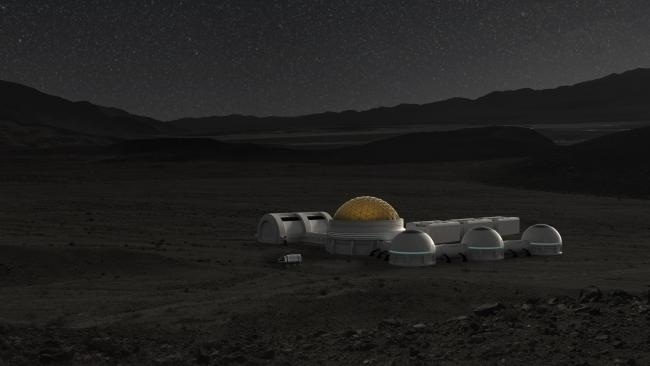
3-D illustration of an imagined space base on a lunar landscape.