
11 Aug 2026
The Center for Astrophysics app, called a Cosmic Data Story, makes it easy to discover the best viewing near you
The Center for Astrophysics | Harvard & Smithsonian has launched a new interactive web app for use during the August 12 total solar eclipse.
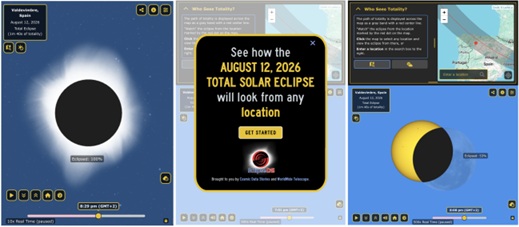
The interface, called a Cosmic Data Story, is built on WorldWide Telescope and works on both phones and computers. It lets anyone, from anywhere on Earth, see exactly what the eclipse will look like from their location at any given time.
“We're making it easy for anybody to understand what a total eclipse looks like and how long the eclipse will last along different locations in the path of totality.,” said Patricia Udomprasert, project director and research associate in the CfA’s Science Education Department.
On a laptop or desktop, users can view a detailed overview of the event, where an interactive map shows the eclipse’s path of totality across Spain, Iceland, and Greenland, and where a partial eclipse will be seen, including much of the U.S. Historical weather data about things like cloud cover can be overlaid on the map to predict the likelihood of clear skies along the path of totality.
On phones and tablets, the streamlined “in the field” view is designed for eclipse day itself: By entering or selecting a location, users can see a simulation of what the Sun will look like at that spot as the eclipse progresses. A built‑in timer offers countdowns to key moments such as the start of the partial phase and the onset of totality.
“This makes it easy for people to know when to put on their eclipse glasses as the eclipse begins, and when they can take them off to see the breathtaking glow of the Sun’s corona in totality,” Udomprasert noted.
The web app also incorporates real‑time weather forecasts alongside the historical cloud‑cover probability. Users can compare locations, consider both long‑term climate and short‑term forecasts, and adjust their plans—even on the day of the eclipse—based on the latest information.
This eclipse explorer is part of CfA’s broader Cosmic Data Stories initiative, which uses sophisticated visualization tools to create intuitive, public‑facing experiences that help people learn STEM concepts.
The web app is available free online and requires no download. Users are encouraged to bookmark the page to use as a live guide. A share feature creates a url that takes the user directly to a specific location. Whether you are in the path of totality or viewing a partial eclipse, this tool offers a clear, data‑driven way to understand and experience the event.