
6 Aug 2026
Preparing for the NASA Lucy spacecraft’s first Trojan asteroid encounters, mission scientists have begun instructing the spacecraft to turn its cameras toward its future targets. From hundreds of millions of miles away, the asteroids appear as pinpricks of light. Yet, these early observations will help the team select the best camera settings for Lucy’s upcoming flybys, starting in 2027.
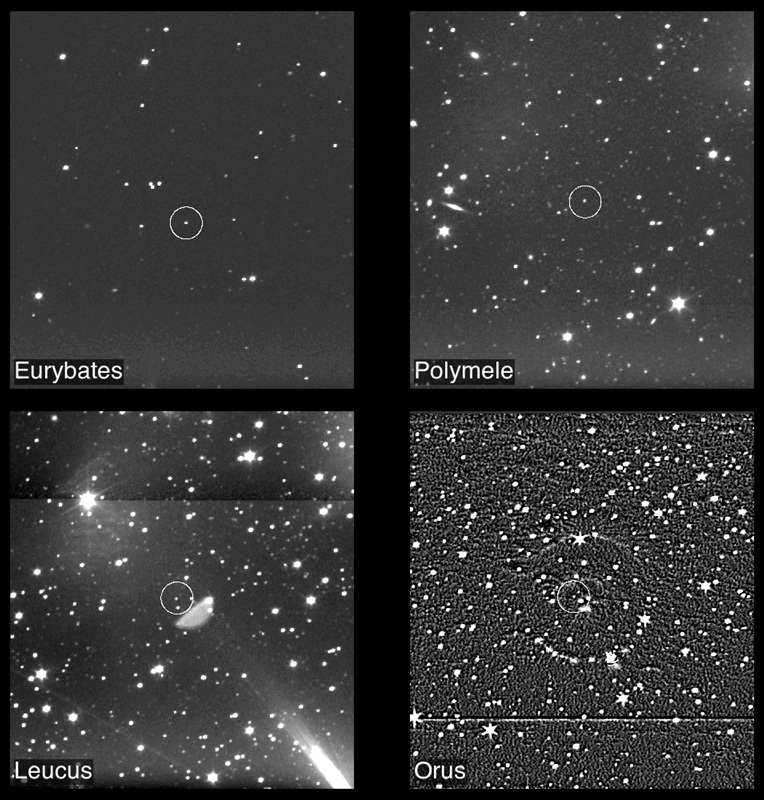
This spring Lucy observed Eurybates, Polymele, Leucus, and Orus with its high-resolution L’LORRI camera, and the team completed downlinking and processing the images in July. The spacecraft will fly past these four asteroids, two of which have small moons, between August 2027 and November 2028. Speeding past at up to 16,000 mph, the spacecraft will snap photos in visible and infrared wavelengths and collect other data as it passes each object.
Lucy is the first mission selected to study Trojan asteroids, which circle the Sun in two swarms along Jupiter’s orbit, though these asteroids aren’t anywhere near the giant planet.
These recent observations are key because Lucy, almost five years into its journey, now sees the Trojans from a different angle than telescopes on Earth do. Astronomers on Earth usually view the Trojans from roughly the same direction as the Sun, making them appear almost fully illuminated, like a full Moon. When Lucy flies past each one, coming within 300 to 600 miles at closest approach, its views will be from different angles, and it will see the asteroid surfaces partly in shadow.
Testing the spacecraft cameras under lighting conditions closer to those expected during the flybys helps the team prepare the cameras to capture surface details without making the images too dark or too washed out.
As the Lucy spacecraft continues its trip to the outer solar system, it will have additional opportunities to observe these asteroids in preparation for the flybys.
[Image]
Four of NASA’s Lucy mission Trojan asteroid targets as seen by the spacecraft in late-March/early-April 2026 moving relative to background stars (circles added to guide the eye). Behind Polymele (upper right) are several background galaxies including one that’s visible as an elongated disc near the left edge of the image. The bright streaks and oval artefact coming from the bottom right corner of the Leucus movie (bottom left) are due to scattered light from a bright star just out of frame called 28 Hydrae, which would be barely visible to the unaided eye viewing from a place on Earth with very dark skies. The faint blobby arc in the Orus movie (bottom right) is caused by scattered sunlight. Orus’ motion is less visible than the other asteroids’ because Lucy took images of it over a shorter time span. The Lucy team plans to get more images of Orus before the spacecraft’s Nov. 2028 encounter with the asteroid.