
28 Aug 2026
The Nancy Grace Roman Space Telescope launches on Aug. 31, 2026 with a wide field of view that is unprecedented in astronomy. Named for Nancy Grace Roman, NASA’s first chief astronomer and a pioneer who helped pave the way for the Hubble Space Telescope and other space-based observatories, the telescope will give astronomers new ways to study the mysteries of dark energy, search for planets outside our solar system, and will investigate the physics of distant stars.
To learn more, we talked with astronomer Christina Lindberg, JC Ryan Post-doctoral Fellow at the Smithsonian Astrophysical Observatory, whose work has focused on looking at stars in nearby galaxies using Hubble Space Telescope data. Now, she’s adapting that research for the Roman Space Telescope.
Here she discusses her work and what she's most excited about as Roman prepares to launch.
Q. Thank you for speaking with us! How does your work connect to the Roman Space Telescope?
A: In my Ph.D. work, I worked on Hubble telescope data, specifically in the area of resolved stars in nearby galaxies. My research has focused on getting multiband photometry of stars in nearby galaxies, or measuring how bright stars are with different filters and at different wavelengths, where they’re still close enough that we can see the stars individually.
Then I use that data to do spectral energy distribution fitting. That lets us learn about things like the stars’ masses, ages, and metallicities, as well as the dust and gas that are in front of them.
Q: How does Roman compare with Hubble?
A: Roman is an imaging telescope, like Hubble, and it has a similar spatial resolution. But its Wide Field Instrument is about 100 times larger than Hubble’s field of view.
That bigger area translates into a pretty dramatic gain in speed of data collection. The Panchromatic Hubble Andromeda Treasury, for example, was a multicycle Hubble survey that took hundreds of hours to image M31 [the Andromeda Galaxy]. With Roman, you can cover the whole thing in something like 14 tiles, meaning 14 separate telescope pointings that you combine into one big image. What took Hubble years will take Roman around 100 hours.
Roman also shifts more toward infrared wavelengths, while Hubble reaches farther into the ultraviolet. So there is some information that will be harder to capture with Roman. For example, the different types of dust and variations in dust properties mostly show up in the near-ultraviolet. For ultraviolet imaging specifically, there really isn’t anything else that can do what Hubble does.
Q: What science excites you most in your own field?
A: I think dust mapping is going to be very transformative with Roman. The Roman Galactic Plane Survey will image a region directly on the center of the Milky Way.
Because Roman observes in the infrared, you can observe stars through more dust before they become too dim to detect. That will let us measure the three-dimensional structure of these dust clouds and other dust structures.
There was also a Cycle One Roman General Observer proposal accepted specifically to target the galaxies M31 and M33. It’s a very large collaboration, with something like 200 co-investigators involved. That will be a really exciting dataset for studying stars.
Q: What is the broader astronomy community looking forward to?
A: The Roman science collaboration is organized into several different areas, including exoplanets, the solar system, the Milky Way, nearby galaxies, quasars, cosmology, and transients. Each of those groups has its own priorities, so Roman is very much a multitelescope, multiproject kind of mission.
To me, the High Latitude Wide Area Survey will be pretty exciting. It will image a strip of sky high above the Milky Way’s disc, which will let us study how galaxies vary over time and investigate gravitational lensing, which is the way gravity can bend light. This can help astronomers understand and map dark matter.
Research into the Hubble tension [the different approaches to understanding how fast the universe is expanding] will also be a major focus. Astronomers can use the predictable brightness of certain stars, including red giants at the end of a particular stage in their lives, to measure distances to nearby galaxies. These studies can help improve our understanding of the expansion rate of the universe.
Q: How long is the mission expected to last, and what will come next?
A: The mission is nominally funded for five years. But that was similar to the original plan for Hubble, and Hubble is still going.
I’m hopeful that Roman’s compatibility with other NASA observatories, including the James Webb Space Telescope and Hubble, will help extend its scientific life. Ideally, over time, we might be able to use Roman to image the whole sky.
The Habitable Worlds Observatory is going to be an important next step, especially for ultraviolet capability. The current development of that observatory is another very large step forward, similar to the kind of major advance that Roman will bring in its own areas of astronomy.
Q: Looking back at your career, how does it feel to be so involved in a mission like this?
A: It’s a nice moment right now because a launch like this causes some reflection in terms of your growth as a scientist. Early in your career, you’re often handed a project without necessarily having the full context for why it matters or how it fits into the field.
Then, later on, you start to appreciate the context for your project and how it fits in with the rest of the field. You see how your work connects to the wider research community and to the questions that other people are working on. That’s what makes it fun.
[Image]
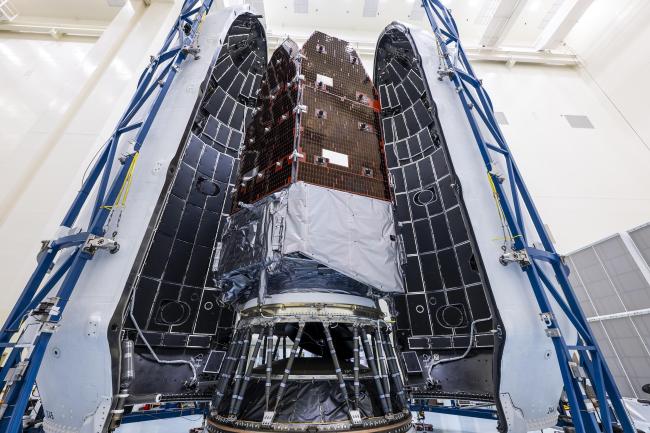
Teams inside the Payload Hazardous Servicing Facility at NASA’s Kennedy Space Center in Florida encapsulate the agency’s Nancy Grace Roman Space Telescope within the payload fairing on Friday, Aug. 21, 2026, ahead of mating to a SpaceX Falcon Heavy rocket.