
5 Nov 2026
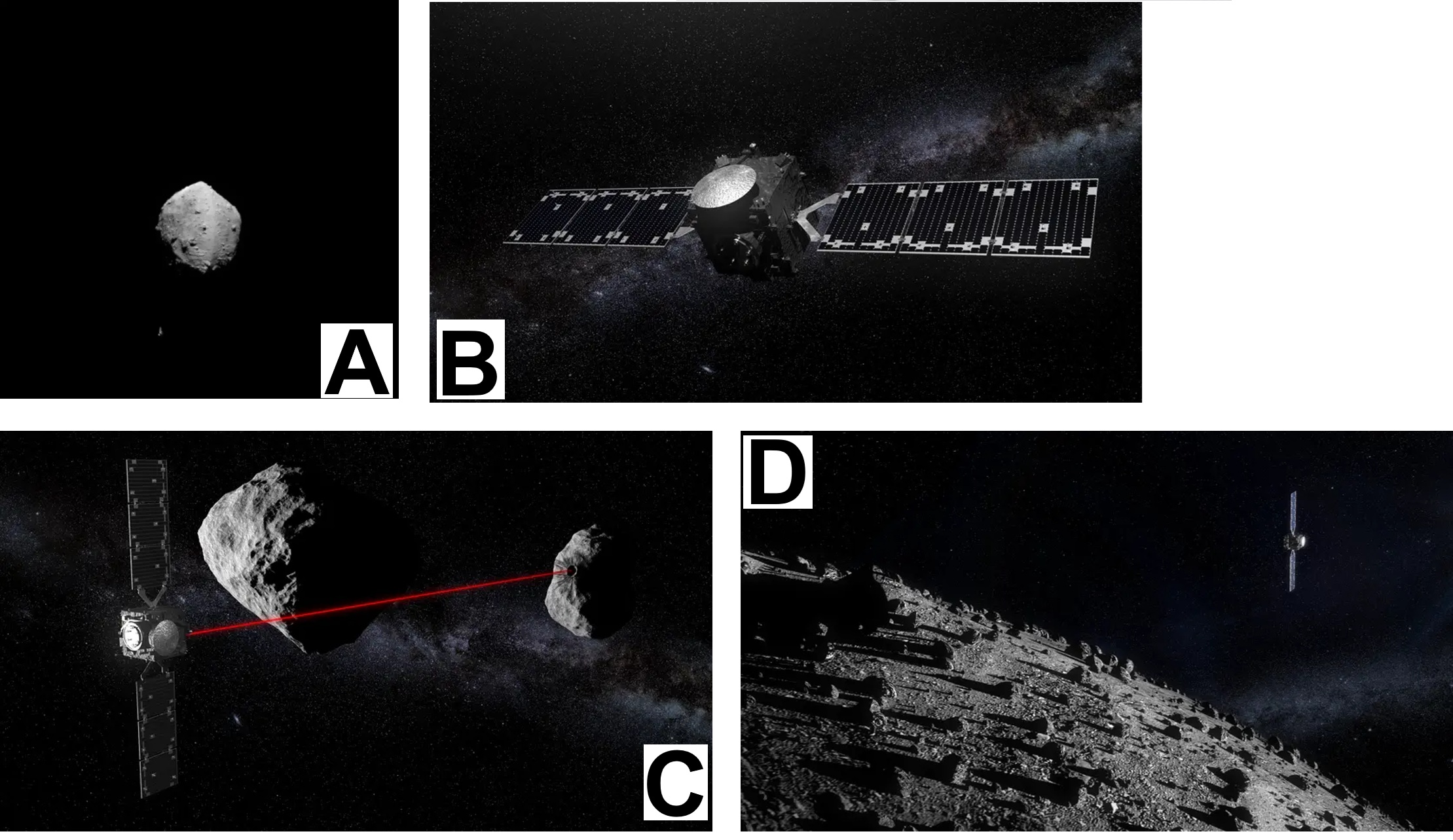
The European Space Agency’s Hera mission for planetary defence has acquired its first close-up of the Didymos binary asteroid system. NASA’s DART spacecraft impacted the smaller Dimorphos asteroid on 26 September 2022 – but this image gives a novel view of its adjacent parent asteroid.
In this image, acquired by Hera’s monochromatic Asteroid Framing Camera from 60 km away, most of the 151-m diameter Dimorphos asteroid is hidden by shadow but the 780-m diameter Didymos asteroid that the smaller moonlet orbits around is shown clearly.
“The first thing we said was wow!” observes Hera Principal Investigator Patrick Michel, Director of Research at CNRS / Observatoire de la Côte d'Azur. “This is the other side of Didymos from the one that DART’s camera showed us shortly before impact, so this feels like looking at a whole new world.
“This side of Didymos has the same central ridge along its equator that we saw before, but otherwise appears very different, with multiple boulders and craters and what look like patterns of grooves or ridges.”
ESA’s Hera mission scientist Michael Kueppers adds: “Since we expect a lot of impact-ejected material to have made it across the approximately 1 km of space from Dimorphos to Didymos, it may be that some of these characteristics originate from this transport of material, and we have exciting work ahead of us to sort it out. We look forward to seeing much more of both bodies and systemically mapping all the changes we identify.”
Mostly unseen in this image, the smaller Dimorphos asteroid is the first Solar System object to have had its orbit measurably changed by human action. Following the impact of the 580 kg DART spacecraft, moving at about 6.1 km/s, the orbit of Dimorphos was shortened around Didymos by 33 minutes give or minus a minute – a much higher change than was previously predicted.
ESA’s Hera, after its two-year flight to these double asteroids – currently 196.8 million km from Earth – is about to perform a close-up ‘crash site investigation’. Hera’s discoveries will help turn the kinetic impact method of asteroid deflection from a one-off experiment to a well understood and potentially repeatable technique if ever Earth comes under threat.
“Seeing this image is a hugely exciting moment for the whole Hera family,” comments Hera mission manager Ian Carnelli. “It has taken years of hard work and dedication to reach this point – but we’re motivated to know that the adventure is only beginning!”
Detailed images of both asteroids will be unveiled on 25 November.
[Image]
(B) Hera spacecraft
(C) Hera scans Dimorphos with its laser altimeter
(D) Hera approaches Dimorphos