
19 Nov 2026
A little more than four years ago, humans moved an asteroid, as NASA’s DART spacecraft impacted a body called Dimorphos. Now the European Space Agency’s Hera spacecraft has arrived at that same asteroid to find out what happened next. Join the Hera team on the evening of Wednesday 25 November as they share the first close-up images of this historic transformed space object.
Our Hera livestream starts from 19:45 to 20:30 CET on Wednesday 25 November. Follow the livestream on ESA WebTV or the ESA YouTube channel.
Join us live for the first images of asteroid Dimorphos
Some 66 million years ago an asteroid impact changed the course of life on our planet, dooming the dinosaurs to let mammals inherit the Earth. On Wednesday 25 November the dinosaur hall of Berlin’s Museum für Naturkunde is the venue to mark a much smaller but consequential impact – the first time that the human descendants of those early mammals managed to shift an asteroid in its course, moving part of the Solar System in a measurable way.
The DART impact on 26 September 2022 liberated millions of tons of debris, triggering a brightening visible from Earth telescopes. Their observations confirmed that the orbit of the 151-m-diameter Dimorphos moonlet around the main 780-m-diameter Didymos asteroid was shortened by about 33 minutes.
But scientists require additional close-up data to turn this ‘kinetic impact’ approach into a well-understood planetary technique that might be repeated as required. This is the job of ESA’s Hera mission, which has just arrived at the binary asteroids after a two-year odyssey through deep space.
“’We’re here to put a dent in the Universe,’ is what Steve Jobs famously declared,” remarks Hera mission manager Ian Carnelli. “Through many years of hard work our international collaboration managed to do just that, and for the very highest of intentions: to help make Earth safer.
“This event will share the first images showing how people altered the Dimorphos asteroid, while celebrating the story of the Hera team who made it happen – even in the face of our initial failure to secure funding, then a worldwide pandemic and finally an incoming hurricane as we were about to launch!”
Hera principal investigator Patrick Michel, Director of Research at CNRS / Observatoire de la Côte d'Azur, comments: “This is a very exciting time for us. First NASA’s DART spacecraft flew to the Didymos system to impact the Dimorphos moonlet, successfully shifting its orbit. Now ESA’s Hera mission has arrived to learn the answers we need to know. How did the impact change Dimorphos? What is the mass of the asteroid and which of its properties explain its response to DART impact? Hera is carrying out a thorough investigation ever of a deflected asteroid, packed with scientific firsts, to give us a complete and unbiased picture of humankind's first planetary defence test.”
ESA’s Hera mission scientist Michael Kueppers adds: “Next week’s unveiling is only the start of Hera’s exploration. In the next few months we will be flying closer to the asteroids, and early in the new year will deploy a pair of shoebox-sized CubeSats to take extra risks and venture even nearer than the main spacecraft!”
Joining Hera’s human team at the Museum für Naturkunde Berlin will be the Hera Space Companion, who you can talk to right now: not just an AI chatbot but a dynamic mission-linked communication platform, designed to make the European Space Agency’s first planetary defence mission accessible to everyone!
[Image]
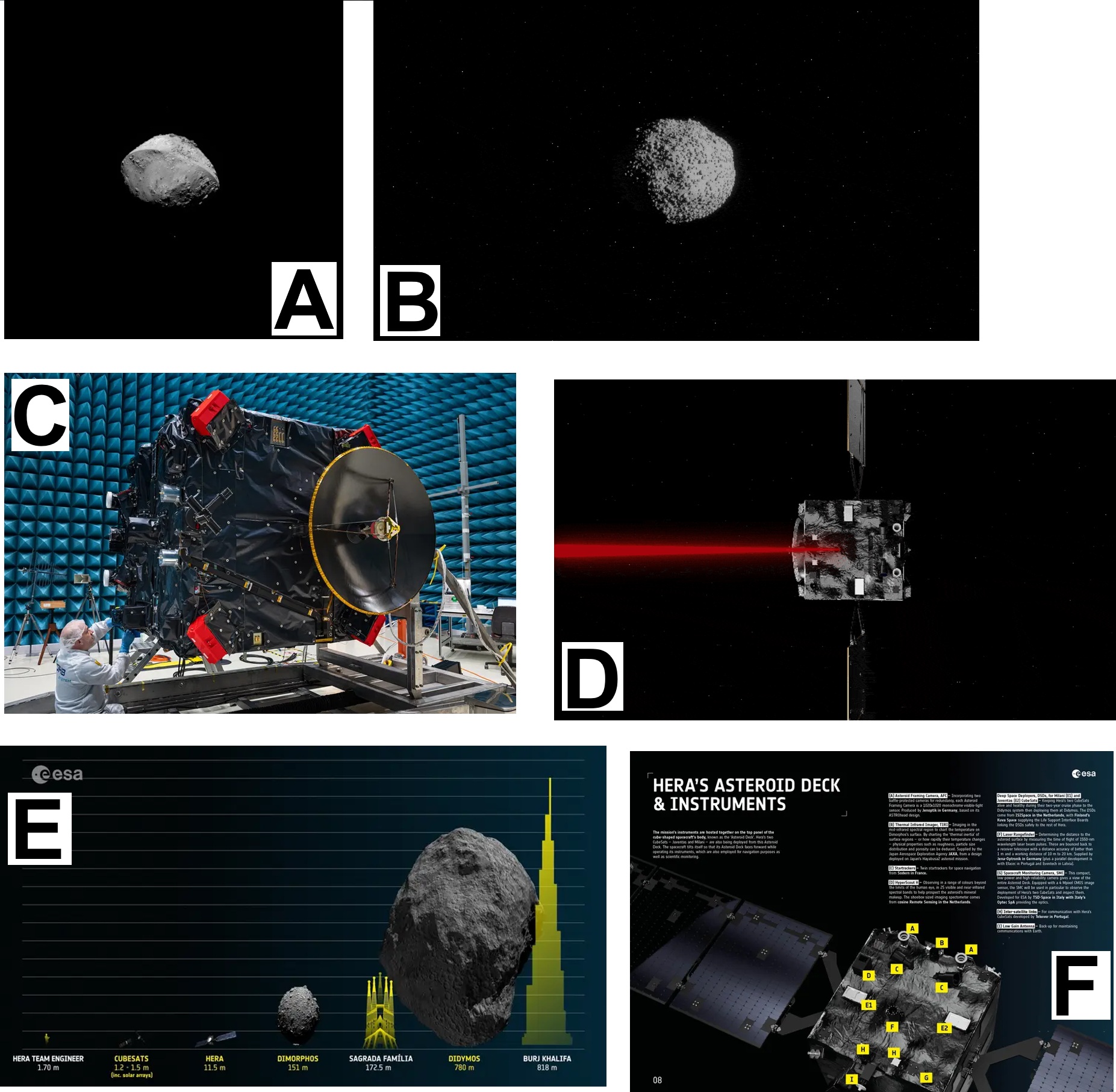
(A) Hera Asteroid Framing Camera image of asteroid Didymos
(B) Animation of DART hitting Dimorphos on 26 September 2022
(C) Hera spacecraft during ground testing
(D) Hera shown surveying the Dimorphos asteroid.
(E) A size comparison between Hera, its CubeSats and its target asteroids with terrestrial landmarks.
(F) A page from ESA's Hera Media Kit