
18 Nov 2026
Even Mars’s more modest volcanoes demand attention. This month’s snapshot from ESA’s Mars Express spotlights Tharsis Tholus, a fascinating peak with an eventful past.
Mars is home to the true volcanic giants of the Solar System. The largest, Olympus Mons, is nearly 22 km tall, over twice the height of Earth’s Mount Everest (this behemoth is not visible here; it is located around 2500 km to the west, out the top of frame). Olympus Mons is just one of several prominent volcanoes found in the vast volcanic province of Tharsis. This group includes the colossal shield volcanoes of Arsia, Pavonis, and Ascraeus Mons, which – although smaller than their record-breaking neighbour – are all taller than any peak found on Earth.
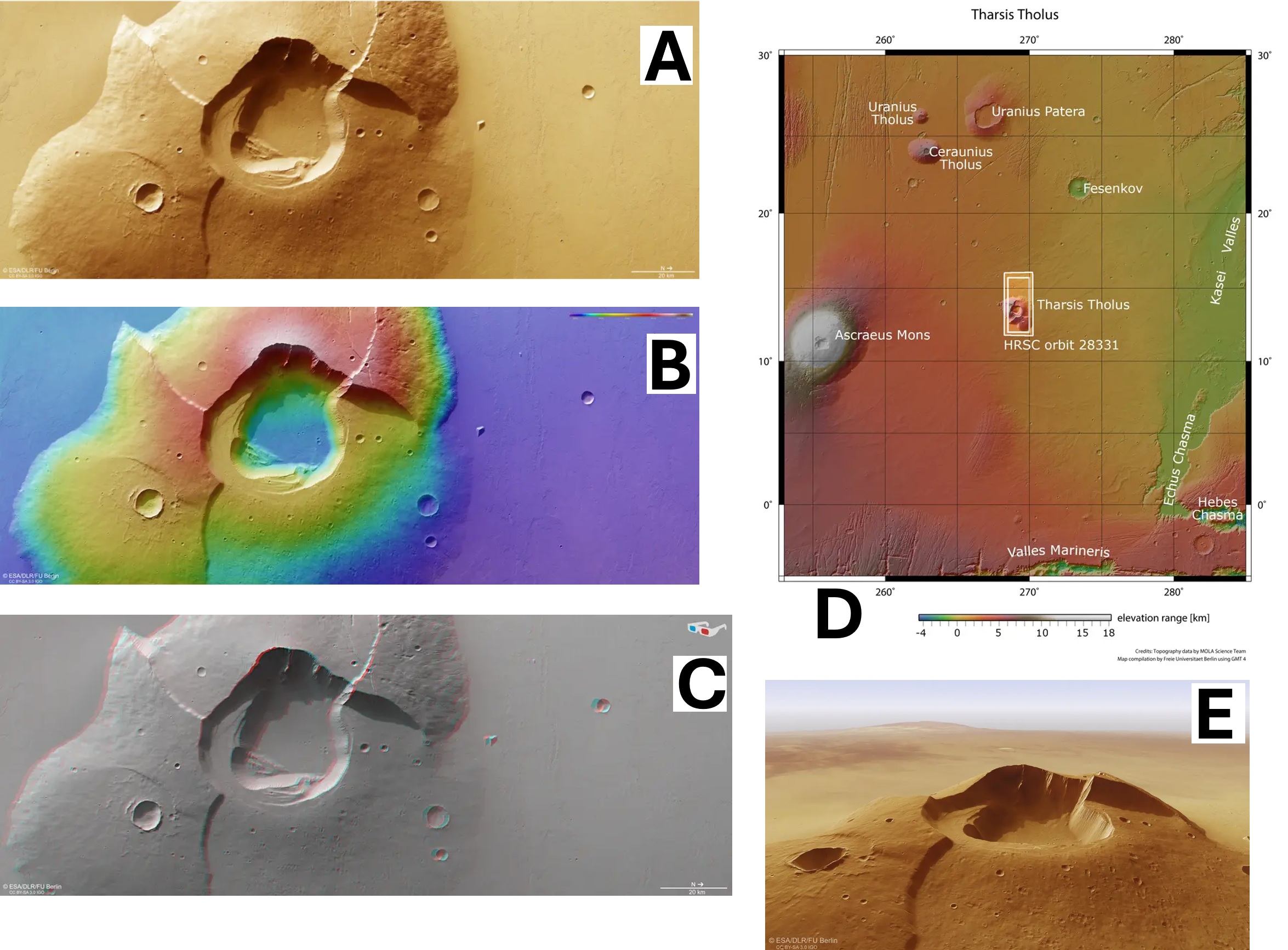
Despite this stiff competition, the subject of this month’s Mars Express image manages to stand out. Even as one of Mars’s more modest volcanoes Tharsis Tholus is still around 8 km tall, similar to the highest peaks of the Himalayas. Its notable feature, shown beautifully in this new image from the High Resolution Stereo Camera aboard ESA’s Mars Express, is its caldera: a large depression at the volcano’s peak.
Calderas form as volcanoes vent their large internal chambers of magma during an eruption, leaving the rock above unstable and prone to collapse. Tharsis Tholus shows signs of at least two subsequent caldera-forming collapses in its past: an older outer caldera and a younger inner one. These are nearly 3 km deep and unusually large relative to the size of Tharsis Tholus itself.
The three images below show 3D perspective views of Tharsis Tholus, generated from the digital terrain model and the nadir and colour channels of the High Resolution Stereo Camera.
Gullies, landslides, and supersized peaks
Tharsis Tholus has had a complex history. The flanks of the volcano have built up over time from surrounding lava flows. They have since been peppered by impacts from space and deformed by various geological processes taking place on the martian surface.
Multiple steep cliffs (scarps) can be seen, likely formed as the colossal volcano weighed down on softer layers beneath the planet’s surface, causing its structure to warp.
We see signs of other cracks across the volcano’s flanks, including faults (fissures where the martian crust has warped and stretched, causing it to fracture) and ‘grabens’ (lowered chunks of land lying between two faults). Small gullies also line the rim and steep walls of the caldera, and there are signs of landslides – both features created by rocky debris flowing down into the central pit of the caldera (as often happens in calderas on Earth, alongside water).
Volcanism on Mars looks quite different to that on Earth. Martian volcanoes can grow truly colossal as the planet has a combination of low gravity and a lack of both active plate tectonics and significant ongoing erosion processes, which allows volcanoes to remain undisturbed above their magma source for extended periods of time.
Volcanism was widespread on the Red Planet several billion years ago, but any remaining volcanic activity, like that seen and reported this month by ESA’s other Mars orbiter, has occurred at a far lower rate. Evidence of Mars’s more volcanic past can be seen in remains like Tharsis Tholus, which started forming some 3.8 billion years ago and is thought to have last pushed out lava just 0.2 billion years ago (recent in geological terms).
Decades of Mars exploration
This image comes courtesy of the HRSC camera, one of eight instruments aboard Mars Express. Mars Express has been capturing and exploring Mars’s many landscapes since it launched in 2003. The orbiter has mapped the planet’s surface at unprecedented resolution, in colour, and in three dimensions for over two decades now, returning insights that have drastically changed our understanding of our planetary neighbour.
[Image]
(A) Tharsis Tholus as seen by ESA’s Mars Express
(B) A topographical map of Tharsis Tholus as seen by ESA’s Mars Express.
(C) Stereoscopic image of Tharsis Tholus as seen by ESA’s Mars Express
(D) Location of Tharsis Tholus on Mars
(E) A birds-eye view of Tharsis Tholus on Mars