
19 Nov 2026
Delivering on its promise, the European Space Agency’s EarthCARE satellite is already yielding new insights into the role that clouds play in regulating Earth’s climate. The latest findings shed light on one of the processes that leads to the breakup of vast, bright cloud formations that help keep our planet cool – with rain emerging as a key driver.
Spanning huge stretches of the world’s oceans, marine stratocumulus clouds act as one of Earth’s most effective natural sunshades. These low-lying, highly reflective sheet-like cloud decks bounce significant amounts of incoming sunlight back into space, helping to regulate the planet’s temperature.
But when these clouds break apart, the picture changes. More of the dark ocean surface is exposed, allowing it to absorb much more solar energy and, therefore, contributing to a warming effect.
This is particularly important because Earth is reflecting less sunlight back into space than it once did. As a result, more solar energy is being retained within the climate system, adding to an energy imbalance that is greater than climate models have predicted.
Recent studies have found that marine stratocumulus clouds are declining, which is one of the causes of this observed reduction in reflected sunlight. Despite the crucial role these clouds play, scientists still don't fully understand why this is happening – or whether this trend will continue or even accelerate as the planet warms.
Understanding how and why stratocumulus clouds change is therefore an important piece of the climate puzzle. Until now, observing their internal structure and evolution from space has been challenging, particularly because these clouds form close to the ocean surface, which makes them harder to profile with previous cloud radars from space.
ESA’s EarthCARE mission is providing a new perspective. Its instruments can probe the vertical structure of clouds and deliver detailed information about cloud droplets, precipitation, droplet fall speed and other properties – including aerosols involved in droplet formation – that previous satellite missions could not observe in the same way.
A recent paper, published in the journal Atmospheric Chemistry and Physics, demonstrates how EarthCARE observations are helping scientists investigate how marine stratocumulus clouds evolve and break up.
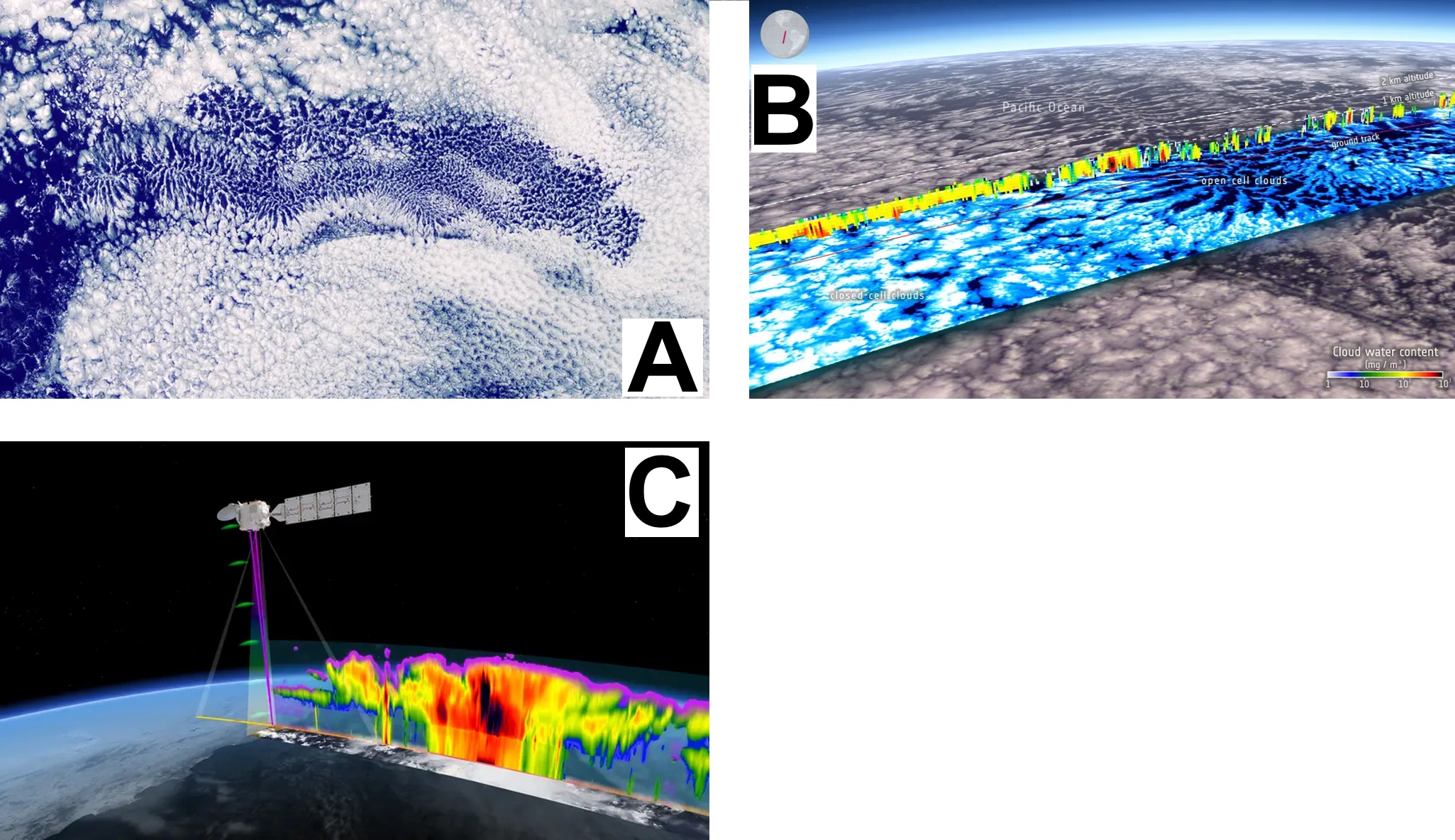
Importantly, cloud breakup does not mean that the clouds disappear completely. Instead, a continuous, highly reflective cloud deck can reorganise from a closed-cell pattern into a more fragmented open-cell pattern. This exposes much more of the dark ocean surface, allowing more sunlight to be absorbed rather than reflected back into space.
Johanna Mayer, research fellow at ESA’s Earth System Science Hub and lead author of the paper, explained, “To investigate what drives this transition, we combined two very different views of the clouds from space. First, images from a geostationary satellite – positioned high above the equator and rotating in sync with Earth – allowed us to track how the clouds evolved over time. EarthCARE then provided detailed snapshots of their internal structure and precipitation properties, revealing what was happening within the clouds themselves.
“The observations point to rain as a key driver of cloud breakup from closed to open cells. They also provide further evidence of a self-reinforcing cycle predicted by theory. As clouds begin to produce rain, falling raindrops remove aerosol particles from the air.
“These particles normally provide the surfaces on which cloud droplets form. With fewer particles available, the remaining droplets grow larger, making rainfall more likely and intensifying the process. Eventually, this feedback can disrupt the air circulation that helps maintain the continuous cloud deck, causing it to break apart into distinctive open-cell patterns.”
These findings help connect processes happening on a tiny scale inside individual clouds to much larger changes in Earth's climate.
Understanding why bright marine stratocumulus decks break up is an important step towards explaining their observed decline – and improving predictions of how these clouds may respond as the planet continues to warm.
Bjorn Stevens, Director of the Max Planck Institute for Meteorology, said, “By applying the techniques developed by Dr Mayer to the growing body of EarthCARE measurements, we hope to better understand the processes that govern Earth’s energy budget and, in turn, influence the rate of global warming.”
EarthCARE is giving scientists an unprecedented opportunity to investigate the processes taking place within clouds. These latest findings demonstrate the mission's remarkable scientific potential, helping to reveal the complex interactions between clouds, rain and aerosols and bringing us closer to understanding how clouds influence Earth's changing climate.
[Image]
(A) EarthCARE tracks marine stratocumulus clouds
(B) EarthCARE measures water in marine stratocumulus clouds
(C) EarthCARE for a better understanding of Earth's radiation balance