
12 Nov 2026
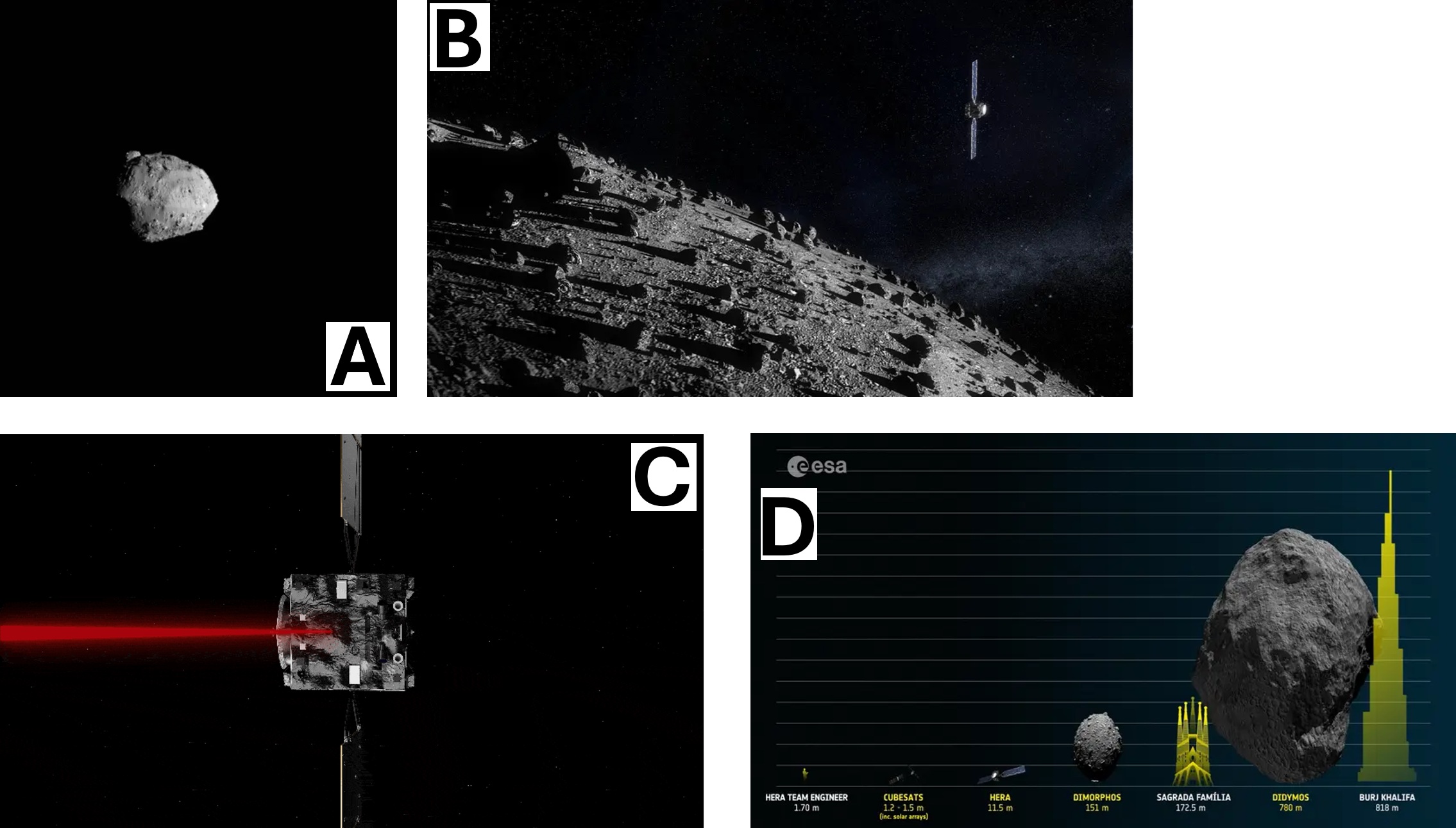
Another early preview of the Didymos binary asteroid system from ESA’s Hera mission for planetary defence. Acquired from 56 km away, this image shows one face of the main 780-m-diameter Didymos asteroid. A small part of its 151-m-diameter Dimorphos moonlet is also visible, peeking out from near the top of Didymos.
This image reveals the geological richness of the larger asteroid’s surface, which includes large boulders, smoother regions and a surprisingly sharp equatorial ridge.
The existence of this ridge may be due to the fact that the spinning-top shaped Didymos rotates every 2.2 hours – fast enough that it is close to coming apart.
Numerical models of fast-spinning asteroids suggest this spin might be causing surface material to flow down from higher latitudes down to its equator. It might even be possible that some material is sloughed off from the larger asteroid – potentially accounting for the existence of its smaller moonlet, Dimorphos.
The mostly concealed Dimorphos orbits a little more than a kilometre from Didymos, with a few boulders visible along its top side. Detailed images of both asteroids will be unveiled on 25 November.
Hera for planetary defence
On 26 September 2022 Dimorphos became the subject of a grand-scale planetary defence experiment when NASA’s 580-kg DART spacecraft impacted the smaller asteroid at a velocity of 6.1 km/s. The resulting collision sent out a plume of debris across 10 000 km of space while also slowing the asteroid’s orbit by around 33 minutes.
But key unknowns remain to turn this ‘kinetic impact’ method into a well-understood planetary defence technique: what did the impact do to the asteroid itself? Did it leave a crater, or reshape the asteroid body entirely? What is the precise makeup, structure and mass of Dimorphos – and which properties explain a deflection so much greater than impact simulations predicted?
Over the coming months Hera will perform a close-up ‘crash site investigation’ of Dimorphos, harnessing multiple instruments and deploying a pair of shoebox-sized ‘CubeSats’ for a still closer survey, eventually progressing to landing.
Meet the Hera Space Companion
Do you have questions about Hera’s journey? Ask the Hera Space Companion: not just an AI chatbot but a dynamic mission-linked communication platform, designed to make the European Space Agency’s first planetary defence mission accessible to everyone!
[Image]
(A) Hera spies a half-hidden asteroid moonlet
Another early preview of the Didymos binary asteroid system from ESA’s Hera mission for planetary defence. Acquired from 56 km away, this image shows one face of the main 780-m-diameter Didymos asteroid. A small ……
(B) Hera approaches Dimorphos
(C) Hera shown surveying the Dimorphos asteroid.
(D) Comparing the size of Hera's target asteroids to terrestrial landmarks